I Spent Twenty Years Watching People Almost Die.
Here's What I Should Have Done Sooner.
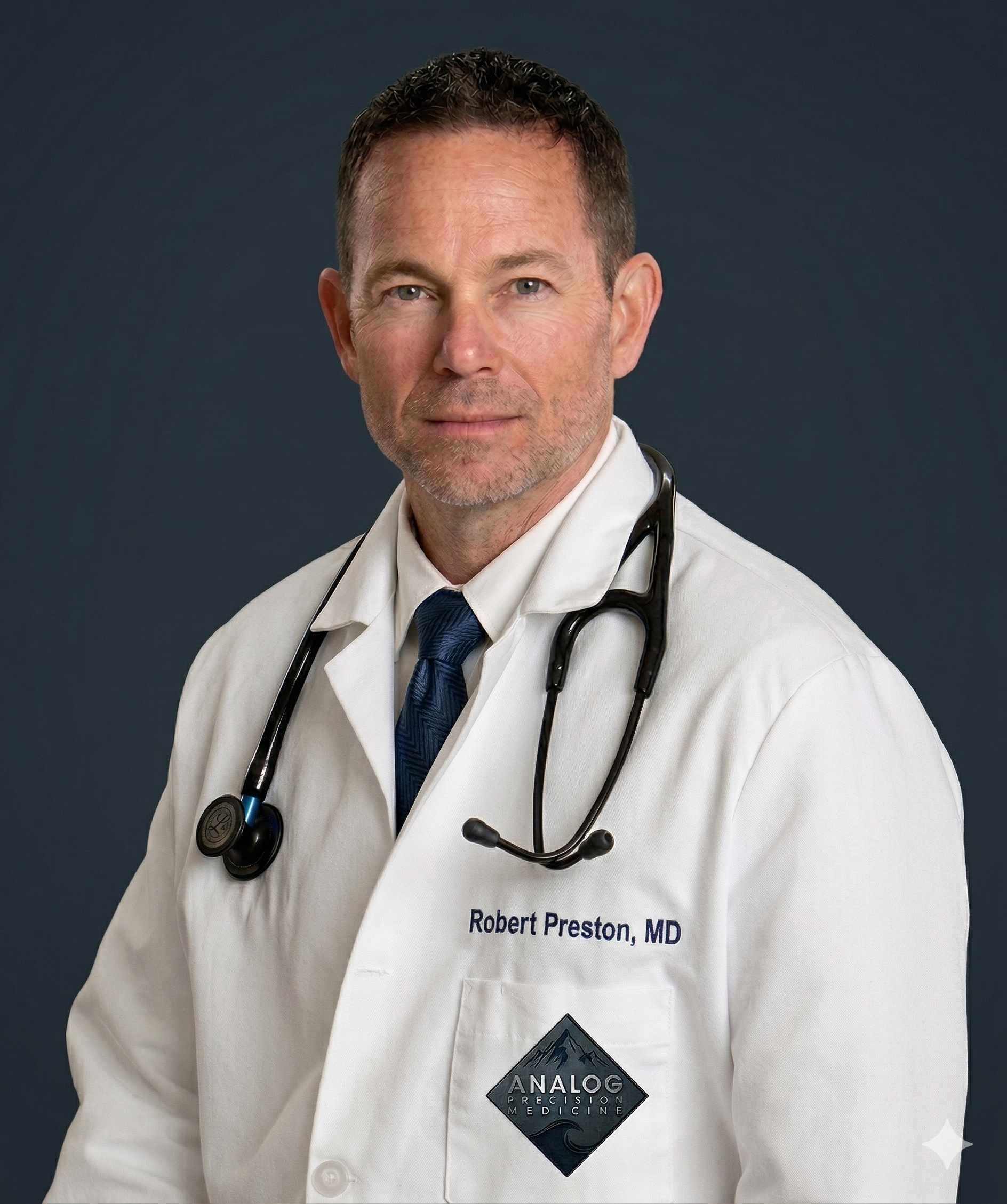
Robert Preston, MD — Board-Certified, Emergency Medicine & Critical Care Medicine — Founder, Analog Precision Medicine
I need to tell you something that took me a long time to say out loud.
I am good at saving lives. I've been doing it for over two decades in emergency departments and ICUs both here in the U.S. and abroad. Cardiac arrests at 3 a.m. Strokes. Septic shock. Multi-organ failure in patients who arrived by helicopter and left on their own two feet. I am proud of that work in a way that's hard to articulate — it is, I think, the most purely useful thing a physician can do.
But there is a sentence I've never been able to say to a patient in the emergency department, not once in twenty years, because it is never true when they're there:
“We caught this early.”
By the time you meet me in the ER, early is long gone. The heart attack isn't starting — it has already started. The stroke hasn't stolen a little speech — it's taken a significant chunk of who someone was. The cancer hasn't been found at a stage where it's easy — it's found at the stage where it has made itself impossible to ignore. Emergency medicine is, by design, the last line of defense. And for a long time, I told myself that was enough.
It's not enough. And I think I knew that before I was ready to do anything about it.
The Patient I Can't Stop Thinking About
He was 54. Came in by paramedic, mid-STEMI, the widow-maker variety. His wife had found him on the kitchen floor. By the time I had him in the cath lab, his heart had been ischemic long enough to scar muscle that was never coming back.
He was going to survive. He did survive. But I stood there after the case — which had gone about as well as a case like that can go — and I kept thinking about his last five years of annual physicals. His cholesterol panels that probably came back “normal.” His doctor visits where nobody ordered a coronary artery calcium score or an ApoB or an Lp(a). His family history of early heart disease that was, I'd be willing to bet, documented somewhere in a chart that nobody ever acted on.
His heart attack wasn't inevitable. It was predictable. And it wasn't predicted.
I've stood in that position, with some version of that thought, more times than I can count. The 48-year-old woman with a stage IV pancreatic cancer diagnosis who'd been having vague symptoms for two years. The 61-year-old marathon runner who presented in complete heart block. The 39-year-old man with a pulmonary embolism whose DVT had been causing leg swelling for three weeks before he mentioned it to anyone.
They all had something in common: they had been inside the healthcare system. They had seen physicians. They had gotten labs. Nobody had been looking for what was actually going to hurt them.
What Emergency Medicine Teaches You That Nothing Else Does
There is a particular kind of clarity that comes from working in an emergency department that I don't think physicians in other specialties get, at least not in the same concentrated form. You see the end of every story that didn't go right. The uncontrolled diabetic who is now in DKA. The man who was told his back pain was “muscular” and is now presenting with an aortic dissection. The woman who normalized her fatigue for two years because she was busy, because her labs were “fine,” because her doctor's visit was twelve minutes long and there was never enough time to dig.
You work in emergency medicine long enough and you develop a kind of backward epidemiology. You start seeing the patterns of what kills people before it kills them. You become acutely aware of the gap between where disease actually starts — years, sometimes decades earlier, at the molecular and cellular level — and where conventional medicine typically meets it, which is when it has already produced a symptom serious enough to drive someone to a doctor or, worse, to an emergency department.
“The tools now exist to close that gap. That is what I'm doing.”
My dual board certification in emergency medicine and critical care also gives me something specific that matters in a precision medicine context: I am not afraid of medically complex patients. I am not going to refer you to someone else when your labs are unusual or your optimization goals are aggressive or your biology turns out to be more complicated than a standard protocol accounts for. I am that someone else.
Why “Analog”
When I was thinking about what to call this initiative, I kept coming back to the same discomfort: that the thing most people fear about precision medicine — that it will be cold, algorithmic, impersonal, a machine making decisions about your health — is the thing I am most determined to fight against.
Precision medicine uses extraordinary technology. Whole genome sequencing. Proteomic analysis. Machine learning-guided pattern recognition across years of biomarkers. These tools are real, they work, and I use them fully. But I became a physician because of what happens between two people in a room — one of whom is worried, in pain, or scared, and the other of whom has knowledge that can help. That relationship is not replaceable. It is not a nice-to-have. It is the point.
I chose the name Analog because I believe the most powerful diagnostic instrument ever built is an experienced physician who knows you well enough to ask the right questions — and has enough time to actually ask them. The technology earns its place here when it makes that relationship stronger, when it frees up the time and attention that used to go to administrative tasks and gives it back to you.
AI handles the data synthesis. The pattern recognition. The chart documentation. The cognitive overhead of monitoring continuous biomarkers. All of that happens in the background so that when you and I are in a conversation, I am fully in that conversation. Not half-distracted by a screen. Not watching the clock. Not moving toward a twelve-minute exit.
The Transition I Couldn't Not Make
I didn't broaden beyond emergency medicine because I got tired of it. I'm not burned out. I'm not running away from something. I'm running toward something that I've been watching take shape for years and finally has the scientific and technological infrastructure to be practiced properly.
The precision medicine field has matured enough that it should no longer be the domain of only academic research centers and Silicon Valley longevity clubs charging six figures a year. The tools are accessible. The evidence base is real. What has been missing — what I think is still missing from most of the precision medicine landscape — is a clinician who has spent twenty years in the highest-acuity environments in medicine and who brings that background to the question of how we keep you from ever needing those environments.
I've coded patients whose heart attacks were preventable. I've watched stage IV diagnoses that should have been stage I. I've held families together in waiting rooms with news that better medicine, earlier, might have changed.
I am not interested in just managing your blood pressure. I am interested in understanding the specific biological terrain that makes cardiovascular disease more likely in your body, and doing something about it before it becomes a problem I have to manage reactively.
“This clinic is the most important work of my career. Not because it's new — but because it should have existed sooner.”
If you've read this far, you probably already understand what I'm trying to build. You know what it feels like to be told you're “fine” while not feeling fine. You know the frustration of a healthcare system organized around treating you the same as everyone else. You know that you are not average. And you're ready for a physician who knows it too.
Come in with your goal. I'll take it as seriously as you do.
— Robert Preston, MD
Founder, Analog Precision Medicine
South Bay, Los Angeles, California